
Shared vs VPS vs Cloud Hosting: Which Is Best For Developers In 2026

Introduction
Have you ever tried launching a project and the hosting confused you so much that you just closed the laptop and walked away for a while? I have been there. In fact, I still remember the first time I tried deploying a small tool I built. I thought hosting would be as simple as clicking a button, but the moment I saw words like shared, VPS and cloud, my coffee went cold and my head went warm.
If you are a developer in 2026, the hosting decision feels even more important. Projects are bigger, users expect faster loading, apps need more stability and every client wants performance that makes them feel like they are using top tier technology. So the real question is simple. Shared vs VPS vs cloud hosting which is best for developers in 2026?
Now let us dive deep into each hosting type with a developer friendly lens. I want you to feel like we are discussing this over a cup of strong coffee while I share my real experiences, examples and everything you need to make the right choice.
You can also read : How Small Creators Can Use AI To Batch Create Content
What Shared Hosting Really Means
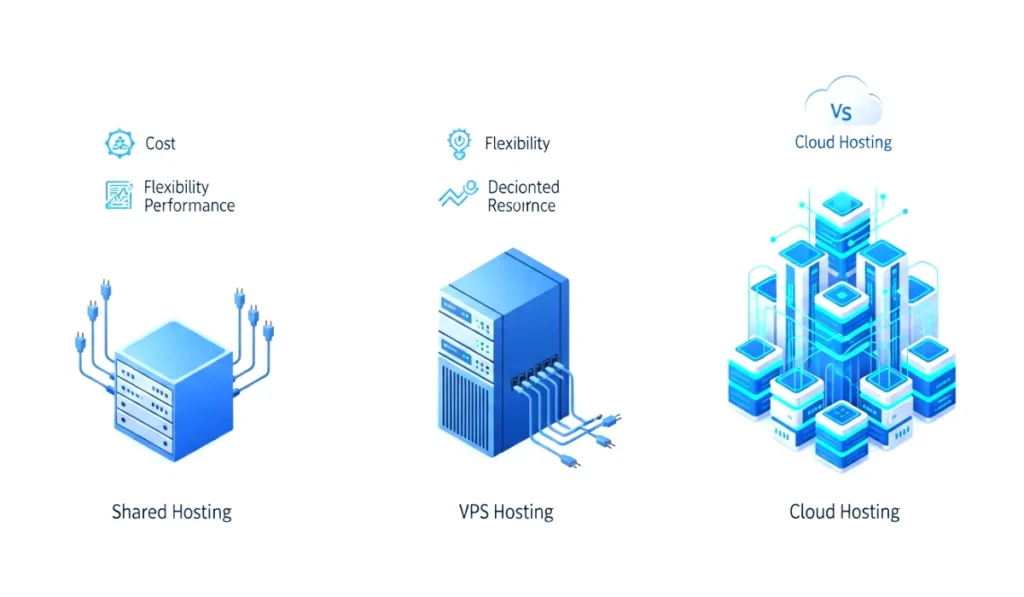
Shared hosting is like renting a room in a very crowded apartment where everyone uses the same kitchen, same washroom and same electricity. If someone leaves the fan on, you pay the price. That is exactly what happens with shared hosting. You share one server with hundreds of people.
It is cheap and honestly that is the only big reason people choose it. If you are just starting your journey and want to deploy a simple static site or a small portfolio, shared hosting does the job.
But let me tell you something straight. Developers who work on real projects rarely stay on shared hosting for long. The moment you need more control, custom configuration or consistent performance, shared hosting becomes a wall you cannot cross.
The best part is that it teaches you the basics. The worst part is that it limits you the day you want to experiment with frameworks, install packages or build scalable backends.
What VPS Hosting Means For Developers
VPS hosting is where things get interesting for developers. Imagine having your own private room inside a big building. You still share the building but your room is totally yours. You get your own CPU resources, RAM and storage.
For developers, VPS feels like freedom. You can install anything you want, run your own environment, configure servers the way your projects demand and test deployments safely. I still remember the first time I switched from shared to VPS. It felt like upgrading from a bicycle to a motorbike. Suddenly everything was faster, smoother and more fun.
VPS sits in the sweet middle. It is more powerful than shared hosting, less expensive than cloud and ideal for developers who want complete control but do not need enterprise scale.
What Cloud Hosting Means In 2026
Cloud hosting in 2026 is a different beast altogether. While shared and VPS use a single server, cloud hosting connects your site or app to multiple servers at once. This gives you better performance, stronger security and near automatic scaling.
If one server fails, the cloud shifts your project to another server in seconds. This is why top apps, SaaS platforms and enterprise projects prefer cloud solutions. It is reliable and made for modern developers who build serious software.
Developers in 2026 love cloud hosting because they are working with microservices, APIs, large databases, AI models, real time features and user bases that can grow fast. Cloud gives room to grow without downtime or panic.
Now if you ask me personally, cloud hosting feels like riding a sports car on an empty highway. Smooth, powerful and ready for any challenge.
Pros And Cons Of Each Hosting Type
Let us break things down in a simple and developer friendly way.
Shared Hosting Pros
Affordable for beginners
Easy to setup
No server skills needed
Includes basic features
Shared Hosting Cons
Slow when traffic increases
No deep customization
Not for backend apps or heavy projects
Security depends on others on the server
VPS Hosting Pros
Great performance for developers
Full server control
Can run complex applications
Scalable up to a point
VPS Hosting Cons
Requires technical skills
More expensive than shared
You must manage security and updates yourself
Cloud Hosting Pros
Highly scalable
Strong security
Best performance
Perfect for apps, tools, APIs and startups
Cloud Hosting Cons
More expensive than both shared and VPS
Learning curve for beginners
Costs increase as resources grow
You see how each type has a place. The important thing is understanding which one matches your project needs.
Performance And Scalability For Developers
Performance is one thing developers cannot compromise in 2026. Users expect instant loading, apps need real time response and every micro second matters.
Shared hosting struggles here because it shares resources with too many users. If their sites get busy, your project slows down without warning.
VPS hosting performs better. You get dedicated resources so a traffic spike from another user does not hurt you. For mid size apps or API based projects, VPS is reliable and efficient.

Cloud hosting wins in scalability. Since cloud uses multiple servers, you can increase your RAM, CPU or storage in seconds whenever your project grows. If your app goes viral, cloud hosting handles the pressure without failure.
Developers who expect traffic or plan to build SaaS platforms always prefer cloud.
Cost Comparison In 2026
Price matters for everyone but especially for solo developers, students and freelancers. Here is how costs usually look.
Shared hosting is the cheapest option. Good for simple sites, early testing and learning.
VPS hosting costs more because you get more power. Still affordable for developers who handle serious projects.
Cloud hosting is the most expensive because of scalability and high performance. But in 2026, cloud pricing has become more flexible with pay as you use models.
If you ask me personally, VPS offers the best balance between cost and performance for developers.
Real Life Developer Scenario
Let us imagine you are building an API based project for a client. At the beginning, traffic is low and the client only needs basic functionality. You could start on a VPS to test and deploy quickly.
After a few months, the client adds payment processing, user accounts and heavy backend logic. The traffic grows and suddenly your VPS resources are maxing out. This is where cloud hosting becomes your best friend.
You migrate to cloud, set auto scaling, configure load balancing and the app handles thousands of users smoothly.
This is how hosting evolves with developer needs. There is no one final answer. It depends on the stage of your project.
Which Hosting Is Best For Developers In 2026
If you want the short answer, here it is.
Shared hosting is for learning and very simple static sites.
VPS hosting is for most developers building real projects.
Cloud hosting is for developers who need enterprise level performance and scalability.

But if you want the clear and confident answer for the question shared vs VPS vs cloud hosting which is best for developers in 2026, here it is.
For most developers in 2026, cloud hosting is the best choice. VPS is the second best and shared hosting is only for beginners.
Cloud hosting gives the speed, flexibility, security and scalability that modern development demands. Whether you are building apps, dashboards, AI tools or full stack platforms, cloud gives you everything you need.
Final Recommendation
If you are just learning, start with shared hosting.
If you are building normal client projects, choose VPS.
If you want future proof performance, choose cloud hosting.
As a developer in 2026, cloud hosting saves time, scales automatically and supports modern frameworks easily.
Conclusion
So the big question shared vs VPS vs cloud hosting which is best for developers in 2026 finally has an answer. Developers who want long term success choose cloud. It delivers the reliability and growth room that modern projects demand. VPS is still a fantastic option for mid size apps while shared hosting is mainly for complete beginners.
Your next project deserves a hosting setup that lifts it up instead of limiting it. Choose wisely and take the step that matches your goals. If you are unsure, start small and upgrade when needed. That is how every great developer grows.
If you want more guides like this, comment or reach out so I can help you pick tools that make your development journey smoother.


3 Comments