Why Problem-Solving Matters More Than Coding Skills

Have you ever met someone who knows five programming languages but still struggles to build even a simple real-world application?
Or maybe you have felt stuck yourself, staring at code that looks perfect but just refuses to work.
I have been there.
Early in my freelance journey, I thought mastering syntax was everything. Java today, Python tomorrow, JavaScript next week. My bookmarks were full of tutorials, and my brain was overloaded with rules. Yet clients kept coming back with the same complaint. The solution works, but it breaks in real situations.
That is when it hit me hard. Problem-solving matters more than coding skills, and not by a small margin.
Coding is a tool. Problem-solving is the mindset behind using that tool effectively. Once you understand this shift, your entire approach to learning and working in tech changes.
Now, let us dive deeper and break this down properly.
What Problem-Solving Really Means in Tech
When people hear problem-solving in programming, they often imagine complex algorithms or math-heavy puzzles. In reality, problem-solving is much broader and far more practical.
In tech, problem-solving means:
- Understanding the real problem before writing code
- Breaking big problems into smaller, manageable parts
- Choosing the right approach instead of forcing fancy solutions
- Anticipating edge cases and user behavior
- Debugging calmly when things fail
Here is the key truth many beginners miss. Computers do exactly what you tell them, not what you mean. If your thinking is unclear, your code will reflect that confusion.
I remember working on a simple login system for a small website. The code was clean. The syntax was perfect. But users kept reporting random logouts. The issue was not my coding ability. The issue was that I had not fully thought through session behavior and real user patterns.
That experience taught me something important. Problem-solving matters more than coding skills because real problems are messy, while code prefers clarity.
Coding Skills vs Problem-Solving Skills
Let us be honest for a moment. Coding skills are easier to measure. You can see how many languages someone knows or how fast they type code. Problem-solving skills are invisible until things go wrong.
Here is a simple comparison.
Coding skills focus on:
- Syntax and language rules
- Framework usage
- Memorizing functions and methods
- Writing code that compiles
Problem-solving skills focus on:
- Understanding requirements deeply
- Designing logic before coding
- Handling unexpected failures
- Optimizing performance and usability
A developer with average coding skills but strong problem-solving ability can outperform a highly skilled coder who lacks clarity of thought.
I have seen this firsthand while reviewing freelance projects. One developer wrote fewer lines of code, but the solution worked beautifully. Another wrote hundreds of lines, yet the product was fragile.
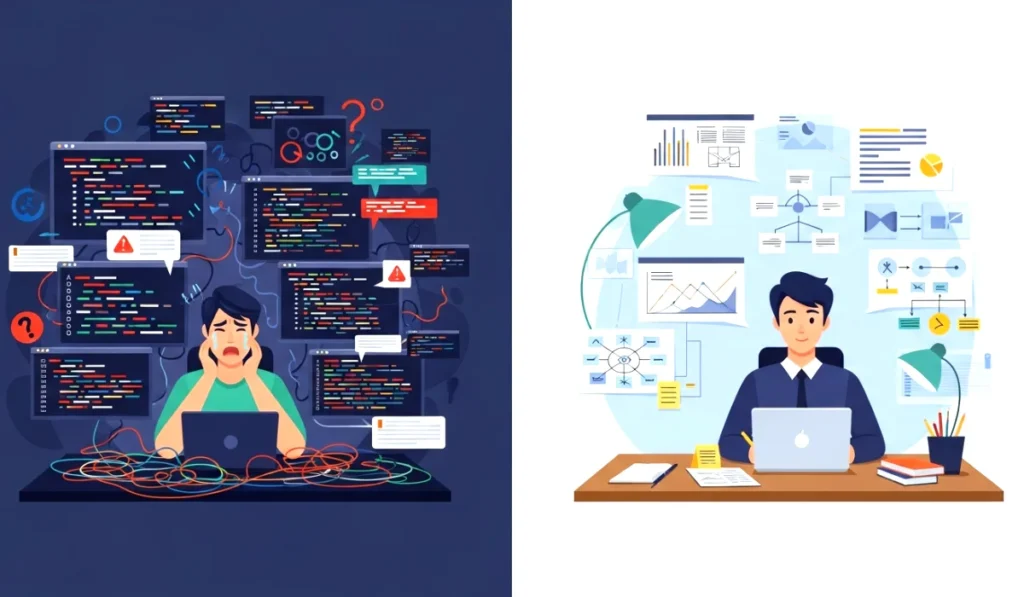
That is why problem-solving matters more than coding skills in professional environments.
Why Employers Value Problem-Solving More
If you ever read job descriptions carefully, you will notice something interesting. Employers often list problem-solving ability before specific languages.
Why?
Because tools change. Logic does not.
Today it is React. Tomorrow it might be something else. But the ability to analyze, adapt, and solve problems remains timeless.
Employers value problem-solving because:
- Real projects rarely match tutorials
- Requirements change mid-way
- Bugs appear in unexpected places
- Users behave unpredictably
- Deadlines demand smart trade-offs
One hiring manager once told me something that stuck. I can teach a smart problem-solver a new language in weeks, but I cannot teach mindset easily.
That single sentence perfectly explains why problem-solving matters more than coding skills in the long run.
Real-Life Examples of Problem-Solving in Action
Let me share a few real-world scenarios where problem-solving clearly wins.
Debugging a Production Issue
A website suddenly slows down during peak traffic. The code has not changed. A coder might panic and start rewriting functions. A problem-solver asks better questions.
Is the database overloaded?
Is caching configured correctly?
Is traffic coming from bots?
The solution often lies outside the code itself.
Scaling an Application
As traffic grows, what worked for 100 users fails for 10,000. This is not about syntax. This is about architecture, data flow, and trade-offs.
Strong problem-solvers think ahead. Weak ones keep patching.
Handling User Experience Issues
Users complain that an app feels confusing. The code runs fine. This is a thinking problem, not a coding one.
Understanding human behavior is part of problem-solving too.
In all these cases, problem-solving matters more than coding skills because the real challenge is understanding the situation, not writing lines of code.
How Problem-Solving Improves Long-Term Coding Growth
Here is something nobody tells beginners. Focusing on problem-solving actually makes you a better coder over time.
When you think deeply before coding:
- Your code becomes simpler
- Bugs reduce naturally
- Refactoring becomes easier
- Learning new languages feels faster
Instead of memorizing, you start understanding patterns.
I noticed this shift in myself after a few years. Learning a new framework stopped feeling scary. Why? Because the underlying problems were familiar. Only the tools were different.
This is another reason why problem-solving matters more than coding skills if you want sustainable growth.
Common Mistakes Beginners Make While Learning Coding
Most beginners are not lazy. They are just focused on the wrong things.
Some common mistakes include:
- Jumping to code without understanding the problem
- Copy-pasting solutions without analyzing them
- Learning too many languages at once
- Avoiding debugging because it feels frustrating
- Measuring progress by courses completed instead of problems solved
I made every single one of these mistakes myself.
The turning point came when I started asking one simple question before coding. What is the real problem I am trying to solve?
That question alone improved my work more than any tutorial ever did.
How to Build Strong Problem-Solving Skills
The good news is that problem-solving is a skill you can train.
Here are practical ways to improve it.
1. Slow Down Before Coding
Spend time understanding requirements. Write the logic in plain English first. If you cannot explain the solution without code, you probably do not understand it fully.
2. Break Problems into Smaller Pieces
Big problems feel overwhelming. Smaller ones feel manageable. This habit alone reduces frustration massively.
3. Practice Debugging Intentionally
Do not rush to Google immediately. Try to understand why something fails. Debugging sharpens logical thinking.
4. Work on Real Projects
Tutorials are safe. Real projects are uncomfortable. That discomfort is where problem-solving grows.
5. Reflect After Solving
Ask yourself what worked and what did not. Reflection strengthens learning.
Over time, these habits compound. And once again, you will see clearly why problem-solving matters more than coding skills.
Problem-Solving in the Age of AI and Automation
This part is extremely important today.
AI tools can write code. They can fix syntax. They can even suggest optimizations. What they cannot fully replace is human judgment and contextual understanding.
AI depends on good input. Garbage input still gives garbage output.
If you cannot define the problem clearly, AI will not save you.

In fact, AI makes problem-solving even more valuable. Those who can think clearly will use AI as a multiplier. Those who cannot will feel overwhelmed.
This is why future-proof developers focus less on memorization and more on thinking skills.
Final Thoughts on Why Problem-Solving Matters More Than Coding Skills
Let us bring everything together.
Coding skills are important. There is no denying that. But they are only part of the equation. Without strong problem-solving ability, coding becomes fragile and short-lived.
Problem-solving helps you:
- Adapt to change
- Handle complexity
- Learn faster
- Build reliable systems
- Stand out professionally
If you are early in your tech journey, here is my honest advice. Do not chase every new language. Chase understanding. Solve problems. Embrace confusion. Get comfortable with thinking.
Because at the end of the day, problem-solving matters more than coding skills, and it always will.
Frequently Asked Questions (FAQ)
1. Why does problem-solving matter more than coding skills for beginners?
Because coding languages can be learned with time, but problem-solving builds the foundation. Beginners who focus on problem-solving understand logic better, make fewer mistakes, and adapt faster when learning new technologies.
2. Can someone be a good developer with average coding skills?
Yes, absolutely. Many successful developers have average coding speed but excellent problem-solving ability. They know how to analyze issues, design solutions, and fix bugs efficiently, which matters more in real projects.
3. How can I improve problem-solving skills in programming?
You can improve problem-solving by practicing real-world problems, breaking tasks into smaller steps, debugging your own code, and explaining solutions in plain English before writing code.
4. Do companies really care more about problem-solving than languages?
Yes. Most companies value how you think, not just what language you know. Programming languages change, but problem-solving skills help you learn any new tool quickly and handle complex situations at work.
5. Will AI reduce the importance of problem-solving skills?
No. AI increases the importance of problem-solving. AI can write code, but humans must define the problem correctly, choose the right approach, and judge whether a solution actually works in real situations.