Frameworks vs Libraries: The Simple Difference Every Developer Should Understand
Have you ever opened a programming tutorial, felt confident for five minutes, and then suddenly thought, wait, is this a framework or a library?
Yeah, same here.
When I first started coding seriously, these two words followed me everywhere. Blog posts, YouTube videos, job descriptions. Everyone seemed to use them like they were interchangeable. But they are not. And understanding the difference between frameworks and libraries can actually save you a lot of confusion, time, and frustration.
So grab a coffee, sit back, and let us talk about frameworks vs libraries in a way that actually makes sense. No heavy theory. No textbook language. Just a clear explanation, real examples, and practical advice you can use today.
What Is a Library in Programming?
Let us start with libraries, because most developers meet them first without even realizing it.
A library is a collection of pre written code that you can use to perform specific tasks. Instead of writing everything from scratch, you call a library when you need it.
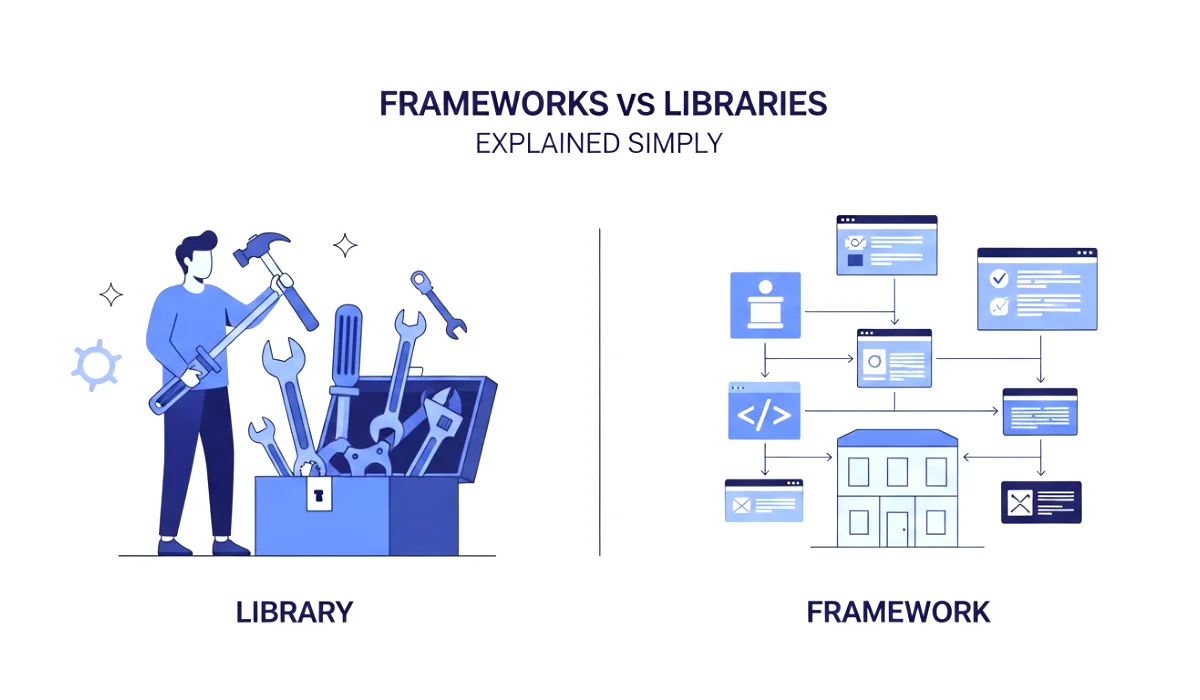
Think of a library like a toolbox in your garage.
You decide when to open it.
You decide which tool to use.
And once the job is done, you close it and move on.
How Libraries Work in Simple Terms
When you use a library:
- You are in control of the flow of your program
- You call the library functions when you need them
- Your code decides what happens next
For example, if you want to:
- Handle dates
- Perform math operations
- Make HTTP requests
- Manipulate images
There is probably a library already built for that.
Popular Examples of Libraries
Some well known libraries include:
- jQuery for JavaScript DOM manipulation
- NumPy for numerical computing in Python
- Pandas for data analysis
- Lodash for utility functions in JavaScript
You do not build your entire app around a library. You simply use it where needed.
Why Libraries Feel Friendly to Beginners
Libraries are usually easier to learn because:
- They solve one problem at a time
- They do not force a specific structure
- You can mix and match multiple libraries freely
When I was new to programming, libraries felt like helpers. Quiet, useful, and never bossy.
You can also read : Why Problem-Solving Matters More Than Coding Skills
What Is a Framework in Programming?
Now let us talk about frameworks, the word that scares beginners for no good reason.
A framework is a complete structure for building applications. It gives you rules, patterns, and a flow that your code must follow.
If a library is a toolbox, a framework is the entire workshop.
How Frameworks Work
Here is the biggest difference you need to remember:
With a framework, the framework calls your code.
This concept is often called Inversion of Control, but do not worry about the term. Just focus on the idea.
When you use a framework:
- The framework controls the overall flow
- You write code inside the framework rules
- Your code plugs into predefined places
You do not decide everything. The framework does.
Popular Examples of Frameworks
Some common frameworks include:
- React and Angular for frontend development
- Django and Flask for backend development
- Spring for Java applications
- Laravel for PHP development
Frameworks are designed to help you build full scale applications faster and more consistently.
Why Frameworks Feel Heavy at First
Frameworks can feel overwhelming because:
- They have opinions
- They enforce structure
- There is a learning curve
But once you understand them, they can massively boost productivity.
Key Difference Between Frameworks and Libraries
This is the heart of the topic, so let us make it crystal clear.
The Core Difference
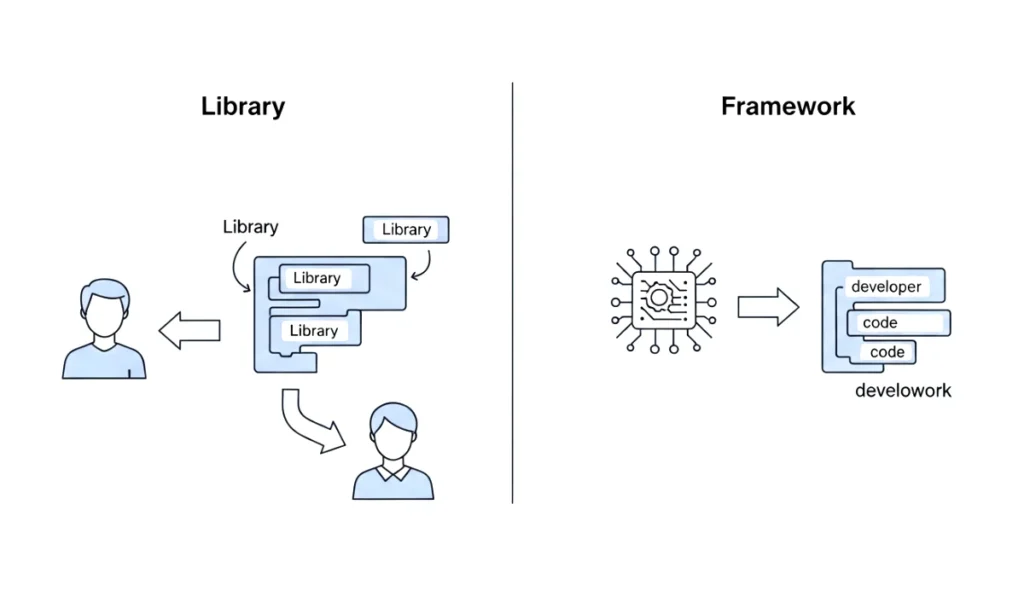
- Library: You call the code
- Framework: The code calls you
That is it. Everything else builds on this idea.
Control Flow Comparison
With a library:
- Your app is in charge
- You decide when to use the library
With a framework:
- The framework is in charge
- It decides when your code runs
Once this clicks, the confusion usually disappears.
Real World Examples of Frameworks and Libraries
Let us use a simple real life example.
Building a House Example
Using libraries is like:
- Hiring a plumber for plumbing
- Hiring an electrician for wiring
- You manage everything else
Using a framework is like:
- Buying a prefabricated house system
- You follow their design rules
- You customize inside the structure
Both approaches work. The choice depends on your needs.
Pros and Cons of Using Libraries
Advantages of Libraries
- Flexible and lightweight
- Easy to replace or remove
- Lower learning curve
- Great for small projects
Disadvantages of Libraries
- You must manage architecture yourself
- Can become messy in large projects
- No enforced best practices
Libraries give freedom, but freedom also means responsibility.
Pros and Cons of Using Frameworks
Advantages of Frameworks
- Clear structure and organization
- Faster development for big projects
- Built in best practices
- Strong community support
Disadvantages of Frameworks
- Steeper learning curve
- Less flexibility
- Overkill for small projects
Frameworks trade freedom for consistency and speed.
When Should You Use a Library?
Libraries are a good choice when:
- You are building a small application
- You only need specific functionality
- You want full control over architecture
- You are experimenting or learning basics
For example, a simple script or a lightweight web page does not need a full framework.
When Should You Choose a Framework?
Frameworks make sense when:
- You are building a large application
- Multiple developers are working together
- Long term maintenance matters
- You want scalability and structure
Most production level applications today rely on frameworks for this reason.
Frameworks vs Libraries Comparison Table (In Words)
Instead of a table, let us simplify it in words:
- Control: Library gives control to you, framework takes control
- Size: Libraries are smaller, frameworks are larger
- Flexibility: Libraries are flexible, frameworks are opinionated
- Learning: Libraries are easier to start, frameworks take time
- Use case: Libraries for tasks, frameworks for full apps
Common Beginner Confusion Explained
Many beginners ask, is React a library or a framework?
Officially, React is a library. But in practice, it behaves like a framework when combined with tools like routing and state management.
This shows that the line can blur in real projects. That is okay. Focus on understanding control flow rather than labels.
My Personal Experience Learning Frameworks and Libraries
When I first learned programming, I avoided frameworks. They felt intimidating. I stuck to libraries and wrote everything myself.
It worked, until my projects grew.
As soon as I started building larger applications, things became messy. Files everywhere. Logic scattered. Bugs hiding in corners.
That is when frameworks started making sense.
They did not limit me. They organized me.
If you are feeling confused right now, that is normal. Every developer goes through this phase.
Final Thoughts on Frameworks vs Libraries
So what is the final takeaway?
The difference between frameworks and libraries is not about better or worse. It is about control, structure, and use case.
Libraries give you freedom.
Frameworks give you guidance.
If you are a beginner, start small. Use libraries. Understand how things work.
When your projects grow, frameworks will feel less scary and more helpful.
Call to Action
If this article cleared your confusion, try this today:
- Pick one library and build something small
- Then try the same project with a framework
You will feel the difference instantly.
And if you are serious about becoming a better developer, understanding the difference between frameworks and libraries is one of those small steps that pays off big in the long run.
Frequently Asked Questions (FAQs)
1. What is the main difference between frameworks and libraries?
The main difference between frameworks and libraries is control. In a library, you call the code when you need it, while in a framework, the framework controls the flow and calls your code.
2. Is React a framework or a library?
React is officially a library because developers control how and when it is used. However, when combined with tools like routing and state management, it can behave like a framework in real projects.
3. Which is better for beginners, frameworks or libraries?
For beginners, libraries are usually better because they are easier to learn and do not enforce strict rules. Frameworks are better once you understand programming basics and start building larger projects.
4. Can a project use both frameworks and libraries?
Yes, most real world projects use both. A framework provides the structure of the application, while libraries are used inside it to handle specific tasks like forms, charts, or API calls.
5. When should I switch from libraries to frameworks?
You should consider switching to frameworks when your project becomes large, difficult to manage, or involves multiple developers. Frameworks help keep code organized and scalable.